Oklahoma: First range-wide lesser prairie-chicken aerial survey concluded
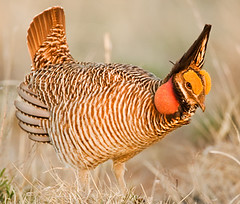 |
| Lesser Prairie Chicken (Photo credit: USDAgov) |
Despite
concerns about the lesser prairie-chicken across its range and the
severe drought that occurred last year across the surveyed region,
biologists were able to make several observations in Beaver, Ellis,
Harper and Texas counties during the survey. The survey was looking for
additional "leks," or areas used by lesser prairie-chickens each year
for courtship and mating.
"This
is an important effort among several partners, and Oklahoma is directly
involved," said Doug Schoeling, upland game bird biologist for the
Wildlife Department. "We don't want to see the lesser prairie-chicken
designated as a federally threatened or endangered species - obviously
first and foremost because we want the species to thrive in Oklahoma.
Also, we feel that the Wildlife Department has exceptional relationships
with our state's landowners and our other partners, which allows us to
have the most beneficial impact on the management and recovery of the
lesser prairie-chicken."
Biologists
with the Oklahoma Department of Wildlife Conservation participated in
the surveys as part of the Lesser Prairie-Chicken Interstate Working
Group, which includes representatives from Colorado, Kansas, New Mexico
and Texas fish and wildlife agencies as well as collaborators from
Western Association of Fish and Wildlife Agencies and West Ecosystems,
Inc of Laramie, Wyo.
The
unique effort included a large-scale, helicopter-based survey to locate
lesser prairie-chicken leks across the High Plains region in the five
states. These surveys encompassed more than 300,000 square miles and the
results will be used to produce the first ever, statistically valid,
five-state lek estimate. Final survey results will be available this
summer.
The
majority of lesser prairie-chicken habitat is in Kansas, and the survey
also discovered leks in Kansas that are beyond what was thought to be
the northern extent of the historic range of the species. Lesser
prairie-chicken numbers have been increasing in Kansas for the last 15
years, while populations have declined in the southern portions of the
range. Biologists believe this northward expansion may represent a shift
in the population of the species as a result of improved habitat and
the Conservation Reserve Program, which provides incentives to farmers
and landowners for converting cropland back to native grasses.
The
lesser prairie-chicken has been considered a candidate species under
the Endangered Species Act (ESA) since 1998, and the US Fish and
Wildlife Service will be releasing a proposed rule on the status of the
bird under ESA in September 2012. Information from these surveys will be
used as a baseline by the state fish and wildlife agencies to monitor
trends in prairie-chicken populations and to target conservation
programs in partnership with private landowners; oil and gas; wind
industry; and electric utilities.
For more information about lesser prairie-chickens and other wildlife in Oklahoma, log on to wildlifedepartment.com.


Comments
Post a Comment